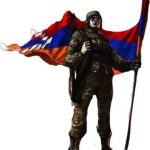
AN ESSAY ON THE PSYCHOLOGY OF THE ARMENIAN FIGHTERS OF ARTSAKH WAR (1988 – 1994)
 Leonid AZKALDIAN, founder of the Azadakragan Panag
Shushi – 2003 –
In memory of my Brothers-in-Arms,
In memory of our ancestors who showed us the Way,
In memory of the exemplary brotherhood expressed by all volunteers, men and women, who gave their life to preserve Life.
_________
I – Understanding the Approach
II – Some Historical and Sociological facts
III – Some Psychological Facts
IV – The Hereditary Instinct
V – Panag
VI – The Fight, a Free Act
VII – The Psychic Enslavement
VIII – The Principle of Finality
IX – The Conditions of Existence
X – The Trial of Transitions
By Arménag Aprahamian
Representative of the Artsakh War Veterans in France
KARABAGH – 1988 / 1994
I – UNDERSTANDING THE APPROACH
It might seem presumptuous, for some persons, to throw through sophisticated means of communication, a glance on the fight of a population who tried to preserve her existence. I shall then put forward two reasons : The first one is that many people asked me to carry out this study, even including some actors of this story.
The second one is that this essay may be considered as some kind of reference, a landmark for those who wish to study and better understand the fighting spirit which was the key to the survival of Armenian populations during the war in Artsakh. Undoubtedly, as we shall see, any act of sacrifice is linked with idealism, and then the ideal should then preceed the act, but it is not dispensable, in addition to the history of war in Artsakh, to make comprehensive syntheses and to contemplate more clearly the aim towards which we want to tend.
Moreover, the one who makes analysis for the purpose of analysis, will inevitably be lead, sooner or later, to penetrate the psychological and even philosophical fields, a complex area to explore if ever. So, why should we fail to give to these esteemable and respectable pioneers, the necessary landmarks to find one’s way in these labyrinthes of the mind, which are as vast as sophisticated ? A major difficulty remained to be solved : how to write such an history in such a restricted framework as the Internet for instance. Any essay worthy of the name should gather thousands of pages, there is so much to tell, to explain, to study. However, when looking more closely, one quickly realizes that the history of Artsakh War to be developed will not burden itself with all the theories developed by historians, thus avoiding subjects like the history of religions, the pseudo politics or the geographic, strategic and economic hypotheses. Present
may lose its clarity and maybe also its depth, nevertheless, the pioneers of knowledge shall succeed in learning what is the Psychology of Armenian Fighters.
Giving an idea of the current situation, the one which now constitutes a sum of knowledge of general interest for the average man, in a language accessible to the less initiated, such is the programme which I decided to follow and will always remain in front of my eyes. I thus expose myself to the outcy of psychologists from all sides, some will reproach me a lack of reference in this precise framework, other
will accuse me of excessive eclectism (broadness of mind) and will blame me for not belonging to any school, which is the accurate truth. To the first, I shall reply that my references are situated at the level of a people bruised in his soul and flesh, of which I was and remain for thirteen years, a faithful companion, to the other I shall answer that everybody has to take his good wherever it lies and at last, that a teacher has not only the right and the duty to restrict himself, but is free to make the choice dictated by his mind and his conscience.
Far from me the idea to keep away a priori the psychologists and psychiatrists to whom we owe the best of our acquisitions, as well as the thinkers who, through their sophisticated reasoning, took searchers away from the generally accepted rational solutions. But I repeat myself, I have the obligation, which is easily understandable, to restrict my report to the essential points and to approach here only the issues of fundamental psychology which concern us. In one word, ally my ambition lies in showing of what
consists the Fighting Spirit of Armenians in the very specific framework of this war.
I shall consider my objective as achieved, if I succeed in awakening the curiosity of readers and raise in
their minds some interest in the study, not only of the history of our nation, but also of the History of our
Fighters.
II – SOME HISTORICAL AND SOCIOLOGICAL FACTS OF THE WAR
February 20th 1988 : Decision and vote of the Regional Council for the self-determination of Nagorny- Karabagh. February 28th 1988 : Mass murder and exodus of the Hay populations of the cities of Soumgaït and Baku. End of November 1988 : Anti-Armenian pogrom in Kirovabad (Azerbaijan). January 1990 : Anti-Armenian pogrom in Baku (Azerbaijan).
From May 1st to August 19th 1991 : Intervention of Russian and Azeri forces in the North of Artsakh. September 2nd 1991 : Official proclamation of independence of the Republic of Artsakh and of the region of Shahumian (Upper-Karabagh). Without unveiling figures which are still a critical subject for the public opinion, it is obvious to explain that, while Artsakh war costed life to about 20,000 persons on both sides, and while there are now about 6,000 war veterans, to be added to the 6,000 Armenian victims and 3,000 missing persons, we may estimate to 15,000 the number of fighters (men and women) who volunteered for the liberation of the Armenian territories of Artsakh.
Fifteen thousand individuals (men and women) decided to take the arms and to sacrifice themselves for preserving the Artsakh land from a bloodbath and an exile programmed since 1903. During Spring and Summer 1991, while continuous bombing methodically destroyed the districts of Stepanakert and Russian and Azeri forces brutally intervened in the region of Shahumian in the North of Artsakh, a stone cutter named Wladimir BALAYAN, helped by his farmer friends from Mardarkert, decided to dig trenches around the village to protect it.
Some time before, a certain Leonid AZKALDIAN, a physicist, joined by Hovsep HOVSEPIAN and young volunteers from Armenia like Manoug, Valod, Micha, Roubo, etc… trained Fedayins in order to fight against bands of armed men which proliferated in the region.
During the same period, in Yerevan, Abarhan and Massis, I trained young men within the specific framework of Hay Djampa training centres, under supervision of the authorities in office at that time, with a view to setting up defence structures. Thus, a meeting took place in Yerevan, gathering all these groups. Considering the abilities and specialities of everyone, the decision to reach within the shortest possible time the region of Shahumian was made. Under the undisputed leadership of Leonid AZKALDIAN, one of the first operational fighting structure of the time was then formed :
THE AZADAKRAGAN PANAG
Leonid, a physicist who had studied the military history of Caucasian war, understood very quickly the strategy adopted by the Azeris to hit the heart of our self-defence structures. But further to several internal divergences in Shahumian, we decided to join Wladimir in Mardarkert. Wladimir, who fully agreed with our strategy, accepted to implement it in his region at the earliest possible time. Thus, the training of the self-defence structures began to develop and a great number of fighters from Armenia and Artsakh joined the Azadakragan Panag.
In a few months’ time, the whole region was under our control. As far as heavy equipment was concerned, our main supplier was the enemy himself, as we could retrieve this kind of equipment in the course of special operations, we desperately needed light equipment.
March 26th 1992 : the Council of Ministers of the Republic of Artsakh created the Committee of Self- Defence.
April 10th 1992 : Mass murder of the Hay populations of the villages of Malagha and Leninavan. I was requested to join General TER TATEVOSSIAN and Arcady GARABEDIAN in order to prepare fighting structures for Shushi operations. A few days later, at the General Staff Headquarters in Stepanakert, Leonid asked the General that I could go back to Mardarkert. The situation on the field was
worsening, the operations against the adverse artillery were becoming very difficult, there was no light equipment in Mardarkert and Azeris were receiving reinforcements from various countries.
Part of our troops was sent to Stepanakert for Shushi operations in May 1992. The simultaneous loss of Wladimir then of Leonid in June 1992 made a deep and indelible scar within the ranks of the Azadakragan Panag. The grief was general as well in Armenia as in Artsakh. The Council of the Azadakragan Panag appointed Hovsep HOVSEPIAN as Commander in Chief.
A few weeks later, the highest authorities gave the order to leave Mardarkert, to protect the Monastery of Gandzassar and the village of Vank, to cut off the road to Vaghouas and block the Azeris in Kitchan. I was in a rage. We thus organized the retreat of women, children and elderly people (several thousands persons) towards Stepanakert.
The order of protecting the monastery was carried out, but the two-thirds of Artsakh territory remained under the control of Azeri forces.
The new order of the General Staff was to take back, whatever it might cost, the territories remaining under Azeri control. The Council of the Azadakragan Panag organized a meeting to make a decision about the operations to conduct in order to take back the burial places of fighters buried in the region of Mardarkert, like Wladimir. The men who had stayed with us were the most experienced ones. The Commandos worked night and day to hit the Azeri strategic positions with light equipment.
At the end of July 1992, at the time of Moghratar operation at ten against one, Manoug SAHAKIAN fell beside me, shot by a bullet in the neck. The hill was recaptured but we had to take back the body of Manoug to Stepanakert and then to Yerevan. All the Commandos of the Azadakragan Panag were present at the funeral.
The decision was made to go back fighting and free our territories. Thus, actions were organized to set up an unprecedented structure in this history, the Martyr Commandos named ARDZIV GOUMARDAG.

August 15th 1992 : the Republic of Artsakh created the Governmental Committee of Defence.
THE AZADAKRAGAN PANAG AND THE COMMANDO TRAINING CENTRES

A reconnaissance patrol
The Azadakragan Panag results from the necessity to constitute an army, which appeared at a time when
the situation in Artsakh demanded the transformation of the villagers self-defence groups into a structured
force organized according to military rules, with a view to the defence against any external aggressions.
This willingness, based on a similar analysis of the situation’s requirements, was shared by all officers of the Azadakragan Panag, according to the abilities of everyone, under the command of Leonid AZKALDIAN, Commander in Chief.
First Period
Leonid AZKALDIAN, born in Yerevan in 1942, an university teacher graduated in mathematics and physics, an early activist of the Armenian democratic movement, very quickly directed himself toward the organization of Hay self-defence forces against the last militarist reactions of the Soviet army which wanted to hinder the full national sovereignty of the Hay people. As he commanded the forces considered as independent, he took part to many operations intended for protecting the demonstrations of the Karabagh Committee, as well as for preventing the last attempts of the Soviet forces to besiege Yerevan, for protecting Hay villages and evacuating the colonizing Azeri populations of Vartenis district. At the same time, taking advantage of his knowledge in physics and gathering with him a group of specialists, he initiated the handcraft manufacturing of the first self-defence weapons. Commanding a military group, Leoniz AZKALDIAN became, after the death of Movses GORGUISSIAN and until he met other experts, one of the commanders of the Independence Army.
Second period
Leonid AZKALDIAN, together with his complete team, after several meetings to exchange opinions and some clandestine stays in Shahumian district, came to the conclusion that everyone agreed on the issue of freeing all Hay territories which were occupied either after mass murder or after ethnic cleansing, especially in Artsakh, and then planned to create an army. This plan became a reality in Spring 1991 as the Azadakragan Panag was formed around several fighters from Armenia and Spyurk. For everyone, Leonid AZKALDIAN then became the Commander in Chief in charge of strategic issues. This operational structure was later completed by a group of volunteer freedom fighters from Mardakert district, who came to receive military training in Shahumian. Their chief, Wladimir BALAYAN, later became the
Commander of the Azadakragan Panag for Artsakh. During this period, the military activity of the Azadakragan Panag has been spreading and developing in Shahumian district, giving a military training to villager fighting groups and organizing the defence and
liberation of many Hay villages (Karashnar, Erkedj, Verishen, Hayparis, Manashid, Talish).
Third period
Further to divergences in military strategies between the Azadakragan Panag and local authorities relating to the organization of the defence of Shahumian District, the Azadakragan Panag decided to transfer its efforts and settled in Mardakert region, namely in the villages of Tchaylou, Mokhratar and Arabégalindj. In addition to its traditional missions of military training, defence and liberation of the villages in
Mardakert region, the Panag constitutes an example and a model in military organization. The fighting efficiency of the Panag, its discipline, its motivation turned it into a special task force for commando operations, requested by the military hierarchy of Artsak to handle all difficult situations on the wholeterritory. The Azadakragan Panag thus served as a spearhead in all fights for the liberation of manyvillages in the regions of Hadrut, Askeran, Stepanakert, Shushi and Latchin. During the attack of Azeri Omons on the towns of Shahumian and Mardakert in June and July 1992, the Azadakragan Panag used all its energy to stop the Turkish progress, supported by substantial technical means recovered in fighting against mercenaries of various nationalities. During these fierce battles, a heavy toll was taken among the Azadakragan Panag with the death of :

Garig BOGHOSSIAN Section Chief killed in Talish
Wladimir BALAYAN Commander of the Panag in ArtsakhKilled in Tchaylou

Leonid AZKALDIAN. Killed in Donashen

Manoug SAHAKIAN
Killed in Moghratar

In July 1992, during the attempts to free Moghratar village, the Panag faced the killing of Manoug
SAHAKIAN “Mer Mantch”. He was with other in charge of the training of new recruits from Artsakh and
elsewhere. In spite of these terrible losses, the Azadakragan Panag continued its mission under the
command of H. HOVSEPIAN and was among the last to leave the town of Mardakert, under command of
the highest military hierarchy, to ensure the security of the population during the exodus.
Fourth period
In July 1992, after the exodus of the Hay population of Mardakert region, the Azadakragan Panag received from the military authorities the order to intervene on the road to Vaghouas to protect the Monastery of Gandzassar and the village of Vank. Thousands of Hays (children, women, elderly people, injured and disabled persons …) found themselves on the roads of exodus towards Stepanakert under the
bombing of Azeri MIG-21’s.

 Since that time, the Azadakragan Panag and its officers remained present and active along the whole front
line of Mardakert region and conducted the whole military operations for the liberation of all villages and of the whole region.
The action of the Azadakragan Panag has been integrated since the beginning in the official structures of
the Hay Armies as soon as they were constituted. Up to now, all officers and military authorities have recognized the value and the specificity of the Azadakragan Panag and the commando (special forces) training centres it has created.
This military structuring work is an unique achievement in the history of our Nation.
The direct participation of the Azadakragan Panag officers in the Eagles Battalions allowed, during winter 1992-1993, the liberation of the territories in Mardakert region, and the Azadakragan Panag officers completed the work by liberating, on April 1st 1993, all territories in the regions of Karvadjar and Latchin.
_________

Since it was constituted in Spring 1991 until February 1st 1993, the Azadakragan Panag lost, while
defending Artsakh territories, twenty-four officers and soldiers. More than sixty soldiers injured during
multiple missions resumed fighting while they were hardly cured.
 As a tribute to these volunteer fighters, who died for the survival of our population and the liberation of our territories, the Republic of Armenia dedicated to them a military museum located under the statue of the Motherland in Yerevan.
III – SOME PSYCHOLOGICAL FACTS
Sensitive life – Affective Life – the Tools
“So everything comes to us from the senses, the Universe itself is known to us only through the effects it is exerting upon us, so that when making every effort to study it thoroughly, this is still ourselves that we are studying …”
As soon as he can assemble a few words and a number of ideas, the child asks a series of How ? and Why ? to those who surround him.
“Why, when I have nightmares, do people want to kill me and I often see myself dying, why does my heart beat so strongly ? Why are small men playing at night in the garden, but what are they doing ? Why do shapes appear in the clouds, wanting to communicate with me ? Is this tall man drawn on the dome of the church my father ? Why do these songs and musics absorb me ? Why do I “love” my grandparents ? Why
do I not understand my father’s language ? Why does my grandfather cut tomatoes and bread with his hands, while other cut them with a knife ? Why do I feel so fine when my mother sings at home ? Why are we constantly talking about “Armenia” without ever seeing her ? Why, on the land of my ancestors, arethere churches without graveyards ? What are “origins” ? Why do water, fruit, meat have another taste in
Armenia than in France ? etc…” (Testimonies of children from Armenia, Artsakh and France) He will, for instance, learn that Armenians have a language which is different from others, an alphabet, an history, customs and traditions. He will also learn that Armenians are sedentary, that they have always been living in their mountains, from their production, their agriculture, their work.
He will learn they are builders, they have invented alphabets for other nations, they are believers and
believe in the divine light. He will learn that other people wanted to destroy the living forces of his Nation, mix with the women and
use the children. He will learn that he had to flee from his mountains and will learn why ? He will learn to distinguish the authenticity of what is good and bad for him, while respecting the choices of his neighbour. He will learn to search for other Armenians and to be wary of some … But, let’s go into the heart of the matter : Why do Armenians have a language, an alphabet, an history, a
culture, traditions ? Why are they builders ? Why did they help other nations to survive and preserve their identity ? Why did
other nations want to destroy them, dominate them, mix with them … ?
You may search into all philosophies, physics, you may even open mechanics, you will not discover any
definition.
To the question : “Why does a Nation want to destroy another Nation ?”, we could answer because it
wants to be unique, but to the question “Why does it want to be unique ?” the answer will be : to become
the final cause that it claims being the only one to know.
The energy itself, of which physicists tell the name every minute, is known by them only through its
effects ; they can be calculated, for sure, energy will be expressed by numbers, it will be transformed into
heat, electricity, motive force, all this can be measured and this will be enough for the phycisist, the
historian, the sociologist, that is to say the one who needs energy under all its forms, but the thinker who
wants to know, who has an unquenchable thirst to understand, will not yet be satisfied. What he desires, is
knowing what is energy in itself, in what exactly and essentially consists one strength, the Strength to
resist against a permanent will of physical destruction of a Nation. And why only physical as, we shall see
it later, the collective soul of a Nation is not destructible because it is immaterial but transferable,
movable, synthetizable to the non-finished (rather than the unfinished, which can be hardly justifiable).
Thus, the scientist only records phenomena and his only concern is to link these various expressions
through ratios. If the latter are constant, our scientist establishes them as physical laws and falls asleep
feeling satisfied.
Can fundamental psychology be turned into a physical law ? Even if the various languages spoken form
the human language, I defy anybody to extract from them a physical law common to all languages ? What
are the sensation, the thought, the joy, the pain, the desire and the hatred ? This is why fundamental
psychology has neither space nor speed nor time, it will only enable to synthesize this series of often
disparate events, to go further, to go back to the origins of the sequence of effects and causes as far as the
mind will allow it.
In fact, how to obtain the supreme explanation if this is not with the help of reasoning ? But this reasoning
itself, what is its source apart from our mind ?
So everything comes to us from the senses, the Universe itself is known to us only through the effects it is
exerting upon us, so that when making every effort to study it thoroughly, in fact this is still ourselves that
we are studying.
We shall thus place Psychology and Ontology in first position : the Ancient Philosophers used the word
“Psychology” only for the study of the Soul (psuké, meaning soul in Greek), but the modern ones
extended the field to Ontology (from the Greek ontos logos, science of the being).
First of all, some schools question the existence of a soul which would be distinct from the body, other
underline that even when admitting the distinction, the body always contribute in some way to the
operations of the soul, from this is issued a kind of psychology which is nothing else but
psychophysiology. My concern will however be to preserve this distinction without omitting that the
psychological fact, one could even say psychic, generally belongs to the living, it is of a vital biological
essence.
We ignore what is the essence of life and it will still escape for a long time to our definitions, but in many
cases, we distinguish it from everything which is not this essence, and we know some of its properties. We
shall thus learn that any sane humane being can get to the demonstration of the existence of the Soul or
Hôki by the only force of reason.
Let’s know examine the organisms from another point of view. Let’s take an amoeba, that is to say the
simplest living creature, made of only one cell, and place it under the microscope, we shall soon see that
our amoeba will react to any contact. Let the scientists explain us as far as they can the movements of our
isolated cell and the way it will resist to the external environment, let’s admit together with them that it
has a character called “irritability” and let’s take a more complex, more sophisticated type of animal life
even lower. There we shall see a phenomenon appear, which externally looks like irritability, but includes
in addition something quite new, the sensation. The animal feels, that does not make any doubt : he will
not only react like you to a pin prick, but will like you show all signs of pain.
But, what is pain, pleasure, a sensation of red or green colour ? If we never had felt something like that,
how could we suspect its existence in the animal and even in our fellow beings ? How can the teenager
discover some of the pleasures of his body, if he did not suspect their existence in his fellow beings ? Are
there still some other sensations or pleasures that none of our fellow beings could yet discover or
rediscover now, and do we have the conscience to explore them ?
One often repeats that the soul does not exist, for the very good reason that no physiologist ever found it
with its scalpel, this reasoning is very bad, as looking at it like that all those who practise vivisection on
dogs or cobayes could be entitled to deny the pain of the animal.
These are phenomena that one feels for oneself, of which one knows the existence in oneself but not in the
others, phenomena which cannot be seen neither touched nor measured, which cannot be located wherever
in space, no mechanics can reach them, no physics can capture them, these facts are from another essence
than the ones studied by the physicist. They occur in a world which is different from the world of the
material, these are psychic or psychological, if you prefer, phenomena.
Thus, it results that, if these psychological phenomena which are pain, desire, sensation, willingness exist
inside us and undoubtedly require immateriality, we are forced to admit that they are products of an
identical nature, that is to say they derive from an immaterial operating principle, from a Soul or Hôki, as
the word is as much important as the thing, mainly in the world of sensations.
IV – THE HEREDITARY SURVIVAL INSTINCT
« If children of Armenia and Artsakh suffer and die, while my own children are safe and healthy, my duty
is to be with them to try to save them. »
To the study of sensations and of states of consciousness may be linked the study of instincts, about which
one can tell marvelous things. No issue is more fascinating and more difficult either.
Animal Instinct
As a great number of animals carry out extraordinarily perfect actions, one could conclude that the
intelligence of their first representatives was much higher than the one of the average human beings and
even though the one of the greatest scientists.
Many engineers, for instance, could not solve the problems posed by a spider’s web, the threads of which
are tightened according the most rigorous rules of mechanics, or the question of the alveolas made by
bees, which occupied a lot of mathematicians.
Human Instinct
But there are two kinds of problems, the ones solved by the instinct are not of an ordinary and general
nature, the solutions apply to concrete issues, let’s rather say to only case, the one of the preservation of
the individual and his descendants.
One may say that some conscious or unconscious states are more or less developed in individuals, and in
particular for Armenians, the hereditary instinct of preservation of the individual and his descendants was
much solicited during the last decades.
It is also assumed that such capacity is one the major psychic reasons for which, considering the
substantial number of external aggressions to which we were collectively exposed, our existence, which
was deeply affected by these facts, is pursued in a permanent search for oneself.
These ordeals, which have been lasting for a rather long time, are the almost paradoxal origin of a
substantial share of the actual foundation of our Armenian society. Wars, mass murders, successive exiles,
in a word the Suffering (the sum of pains) irremediably affected our subconscious states.
Pain and Psychophysiology
In fact, every sensation leaves an organic trace, more or less intense in the memory, the origin of a
secondary image which may come back and appear suddenly in the field of consciousness. All these states
create an unquestionable organic resultant and this resultant forms our subsconscious, permanently in
motion to play a role in our psychic life.
If a physical pain appears, the sensation is transmitted to the brain through the nerves of sensitivity via the
spinal cord. In fact, this stage calls for an immediate reaction, an order is given by the brain to act
physically in order to eliminate the origin of pain. This time, the innervation works backwards, following
the same route, but through the motor nerves. Is it always the case ? No, because even after removing the
brain, motor reactions may take place. The reason is that other nervous centres exist, playing the role of
relays and thus directly triggering motor actions off.
This immediate reaction is called a reflex motion. The action is there independent from the willpower, it
occurs inside us automatically, with an objective of defense and preservation. On the other hand, a
frequently renewed sensation to which succeeds the same motor response determines, after a certain
period of time, the acquisition of reflexes and thus creating the automatism which is so valuable to us,
because from this moment on, a number of our actions do not burden any longer the field of
consciousness, as they have become unconscious and do not require our attention anymore.
The Instinct and its finalities
« We were boosted in our fight as if an aim required it. »
We must take into account our sensations because the instinct is blind, it ignores the aim, however, the
humain being, thanks to his psychism and his acquired experience may adapt himself more easily, vary his
means somewhat, even improve his hereditary instincts, but the latter nevertheless remain the basis for his
operations. Thus, for instance, the aim of bees is before all accumulating sugar, all of them harvest it on
flowers, this does not prevent that, close to a sugar refinery, they do not gather nectar any longer, they loot
the sugar made available to them, the method is different, the aim remains the same, but the quality of the
result is not identical.
This is often the case in our Armenian society, within the context of political struggles which are
conducted for such and such purpose, which such and such alliance, for a quality of result which remains
to be discussed.
One often repeats that the prerogative of the instinct is « infallibility ». The proposition is far from being
accurate as far as we are concerned, because the act is always completed by a fact of consciousness where
psychism is involved. Instictive acts are especially « infallible » in the natural branch lines (plants,
animals) as the psychism increases ; the personal habits, the experience acquired, the ruses are developing
and the field of instinct decreases proportionately.
In such case, it is obvious that, for reaching his aim, the subject has more flexible means, capable of a
closer adaptation to the infinitely varied circumstances proposed by life. But will he be able to make the
difference between natural and synthetic sugar ?
This will always be the case regarding the absolute hereditary instinct (the Source), which is nothing but
the Cause of a sheer act, the aim of which will be the preservation of his life and descendants.
« The mountain men of Armenia used to say that a source is no longer wild once it flows through a
pipe. »
The issue of finality reappears. This finality may be real or apparent, but the enigma remains, everything
happens in the Universe as if it was governed by a thought emanating from a exceptionally intelligent
being, as the means used to reach an aim are always adapted for an objective which preserves the being
and constantly tends towards perfection. Even if we purely and simply substitute the action of an
intelligent Being by the action of the Nature, the question does not progress any further, thus we must find
the reason for which we act cleverly and direct the acts towards useful purposes with a view to real
progress, this is already part of another chapter.
V – PANAG (THE ARMY)
We have at least one certainty, should there be only one sensation in the world, mine, the one I feel right
now and which consisted in seeing the suffering I attribute to the children and families in Artsakh, it may
be right or it may be wrong, I am sure that one thing exists, this sensation of inner pain, similar to a
wrench which grows in intensity.
« the pogroms of Soumgaït, the brutal exodus of the Armenians from Kirovabad, the walls of the
kindergarten riddled with bullets, the odour of rubbish in the cellars of Stepanakert among refugees, the
cries and tears of the Armenians from Shahumian, the dead and the wounded. »
Thus, there are obvious things which do not need to be demonstrated. The psychological phenomenon of
sensation may be included in this category. What I still know is that such phenomena can reappear inside
me, this succession of photos, odours, cries, whether I want it or not, all these sensations are totalized by
myself, it is obvious to me that they affect me, they belong to the same field, they are mine. I have a sort
of invisible intuition telling me that something links them and, when these sensations appear, I still have
the certitude that I have nothing to do with it, that they belong to me for the rest of my life, they are
imposed to me, even when I do not want them, if I close my eyes, the photo disappears and I also that I
can make it reappear at will when closing my eyes.
Thus, behind these transitory phenomena which form as psychologists say « the direct current » of
consciousneses, I am compelled to admit that something exists which constitutes the link between these
states of consciousness. In front of them, there is something like a spectator which records them and this
spectator is me. Me, but also all my comrades who think of only one thing, freeing themselves from the
Cause which is the origin of the pains and of their awakening.
In the Universe, certain things can be divided and others cannot be divided. The things that can be divided,
I call them the « material » and they appear to me as an expanse, the ones which cannot be divided are the
« immaterial » and are not an expanse. On one side, there are phenomena which pass by and on the other
side something which stays, the support is the substance, the transitory states which affect it, what
philosophers call « accidents » and what physicists call « phenomena » are our states of consciousness.
Through these ways of being, our Hôki (Soul) feels her existence, feels herself living. This kind of
splitting of the consciousness which makes the Hôki feel herself, like a mirror which knows its image,
which holds the privilege of watching herself both as subject and object, there lies the very basis of the
Psychology of Fighters.
If one wonders how to represent our Hôki, the question is badly posed. Representation means here an
image of organic nature and if our Hôki does not hold any of the body’s properties, no image can
represent her. But we can very well fee her acting and even imagine her, this new property held by our
Hôki is our faculty of Thinking.
We became aware of the vital importance of setting up a military training programme to ensure the safety
of the population.
The idea which we had to create a defence structure equalling the other armies in the world to protect the
Armenian populations, the strength of which would be proportional to the suffering of our Nation, this
idea has a name,
THE LIBERATION ARMY, « THE AZADAKRAGAN PANAG »
The idea of creating our army is thus part of a particular language of spiritual nature, having as substance
the collective Hôki (Soul) of our Nation and as foundation, the sacred land of Artsakh.
This idea is thus the result of a particular act of our Hôki, which was exercised by a special faculty on
sensible data. The body gives us only particular sensations perceived as such by our sensitivity. But the
faculty of perceiving the general idea is totally different : without this faculty, it would be impossible to
understand the ideas of substance, being, cause, effect, succession and infinity. This new faculty of our
Hôki is what philosophers call intelligence, understanding, or simply reason.
In one step, the obstacle was overcome, the Armenians took their shotguns and automatic weapons to
gather themselves around this new structure, enabling some of them to restart the training forgotten for a
short time, as ten years before, the Soviet war in Afghanistan already employed them to fight against the
local populations.
« The difference being that this war is our war, the one which lasts …. »
VI – THE FIGHT, A FREE ACT
« Why had we to take back three times in a row the same position, while we could have kept it after the
first operation ? »
If we have the deep feeling that we can act or not act, resist these tendencies or give them free rein and
this is where lies what we may call « our Freedom ».
« Let’s everyone listen to and consult himself, he will feel that he is free, as he will feel that he is
reasonable » Bossuet says. A mere illusion, determinists will say. Our will may be compared with scales
which tips towards the side where you uncounsciously put the strongest motives.
Thus, let’s analyse very seriously the conditions under which occurs the morally free act. At the moment
where I am training, a friend comes and asks me to take my equipment and warn my unit of an imminent
fight, further to an external aggression. I immediately have an outlook of the acts to be carried out to reach
an aim.
But, to carry out these acts, I have to move, to interrupt my work which is itself vital for me, I have to call
my officers and organize the movement of the unit, taking into account the risks involved by this kind of
operation ; on the other hand, how can I refuse, my duty to protect the women and children is an evidence.
All these ideas come simultaneously to my mind and form as many motives to act or not to act, towards
one direction or another. I consider all these motives to deliberate intellectually, even if I am not quite
aware of the whole consequences of the decision. Finally, the decision is made, I have made a choice, one
can now switch to the action.
Among all these acts which succeeded to each other during a short period of time, honestly speaking,
which one can I consider as free ?
Obviously, this is neither the outlook which is itself imposed nor the consideration of the motives or the
deliberation, as the motives appeared to me as necessary means, this cannot be either the completion of
these means which the aim dictated to me. There remains only the decision to be examined, if my act is
free, this is only thanks to my decision. Is this really the case ?
Let’s go farther in our analysis and absurd reasoning ; let’s assume that my decision is not free, but a
necessity ; then, I have to find the reason for this necessity, this could come only from my intelligence,
which presented me successively different kinds of benefits, difficult to compare in the absence of a
common measuring unit. The benefit for me was, for instance, not to move, considering the extremely
hazardous circumstances, and the benefit for the endangered families was quite opposite to mine. One
does not appear to me more necessary than the other. As it was not required de facto, the basis of my acts
must necessary lie in the choice, that is to say in my decision.
Thus, the freedom essentially consists in the choice, that is to say the interruption of the indetermination
where lies the will in the presence of various benefits proposed by the intelligence.
VII – THE PSYCHIC ENSLAVEMENT
AGHABEGALENDJ – (region of Mardarkert), on April 15th 1992 at 10 a.m., further to a breakthrough of
the Azeri forces in our defence lines close to Tchaylou, gathering of the units, roll call and preparation for
the departure then transfer of the troops to Tchaylou village.
Accurate identification of the enemy positions and organization of the defense of the village :
– 1st notice : the Azeris are positioned in the « Goms » (stables) supported by three T72 tanks ;
– 2nd notice : there is no vegetation on the hills located between the village and the stables, the terrain is
thus completely exposed ;
– 3rd notice : we have no artillery, no air force, only RPG7’s to stop the tanks sending projectiles, the
salient and white-hot fragments of which, after exploding, go into a spin following so varied
trajectories within a radius of 30 m, that the probabilities of not being touched are substantially
reduced.
The only possibility to protect the village and the civilian population is to make a diversion among the
Azeri troops so that other groups can get closer to the tanks and shoot them on the ground using our mere
bazookas.
We thus constituted groups of antitank volunteers and struggled against scrap heaps which I call massive
human destruction weapons, at the expense of our own life.
How can the final cause of the survival of someone else be stronger than our own instinct of selfpreservation?
This spontaneous move, which implies a tendency to an useful ending is essentially psychic.
The personal situation of each individual, his personal difficulties, his own sensations (cold, heat, fear and
pain) are completely inhibited by a higher psychic capacity which is the Will. Thus, above the particular
benefits, the intelligence conceives an ideal good which attracts her, an abstract good which is simply the
Good itself.
Our fighting spirit represents the immediate principle of the acts through which we we tend towards an
abstract good which is the preservation of our families and descendants, our particular and individual
instinct has thus turned into a Collective Good which corresponds with our collective Soul, the Soul of a
Nation.
All these preliminaries are necessary so that we may not mix up inside us the desire and the will, making
such a distinction is of the utmost importance.
Undoubtedly, any desire implies a tendency to carry out a movement and in this sense, represents an
automatic and spontaneous activity, but very often isn’t it true that we do not follow up these impulses that
we undergo passively (Self-Control) and we stop them thanks to our thoughtful and conscious will.
In any case, we feel the real cause of the non-completion of these tendencies, we are aware of the action of
our will, in the same way we have an intuition of our sensitive or intellectual condition.
Our Soul or Hôki being immaterial, having no expanse, will consider the Energy as a substance, whatever
may be the good that I conceive and imagine, the same mechanism will be reproduced, a biochemical
phenomenon of a vital nature, a sensitive impulse, resulting in a mechanical movement in which all the
laws of the energetics will be complied with, proportionally to our states of consciousness.
The Will shall enslave our psychic states allowing the energy to conduct a biochemical and biomechanical
process towards an Universal Good conceived by our intelligence.
VIII – THE PRINCIPLE OF FINALITY
The Subsistance of the Soul of the Fighter
As stated before, our will shall « enslave our psychic states allowing the energy to conduct a biochemical
and biomechanical process towards an Universal Good conceived by our intelligence. »
Fighting an enemy who destroys life thus represents for Armenian fighters an act directed towards an
Universal Good conceived by our Intelligence associated with our Instinct.
This is the perpetual fight between Hayk’s people and the destroying Spirit, the eternal and permanent
fight which implies to understand and to have a total Faith in this mission against the transient life.
In spite of these definitions, let’s however try to go deeper into this subject and let’s ask us the
philosophical question of the « Why » ?
If we do not fight to preserve our existence and the one of our compatriots, we shall die, as nothing will
prevent the adversity to destroy us physically, neither us of course (mere hypothesis or postulate) nor the
allies who are not present there, nor the international authorities which admit the eventuality of seeing the
Hay population of Artsakh being killed almost in totality, a corridor between Artsakh and Armenia
allowing a few survivors to flee.
The whole world had already accepted the idea of the total annihilation of the Hay population of Artsakh
in August 1992.
The principle is thus obvious, the means are clear, then why fight, why not simply die ? and more
generally, why preserve an Armenian life and can we preserve this Armenian life without fighting ?
Why, paradoxically, cannot the fight for the recognition of the Genocide be the only fight against the
Genocide ?
We shall try to answer all these questions in this chapter.
We think, probably wrongly, that the Death of our Nation is as much a physical death as a spiritual death,
we do notice it in phrases like the permanent Genocide, the white or cultural genocide, the death of
Armenity.
All the more that we feel and think that we notice inside us (this sensation is once more collective,
common to all of us) a loss of Armenity, a loss of identity, a progressive transfer of our culture, but would
not all this be an illusion, can a Soul have an identity ? This after having well understood in the preceeding
chapters that the Armenian Soul or Hôki is an immaterial substance.
Why not let our Soul merely die ? This is not that simple, can we really do that ?
Do we know how she appeared, so that we could know how she could be extinguished ? Only the one who
is his creator could destroy her, we are only the vehicles of a Hôki or Soul who only wants to be expressed
on a path which is Armenity, but most frequently, this expression is slowed down for many pretexts by
our own will, as for a long time, we have acquired the reflex of hiding our Armenity. We are thus the
cultural victims of our own will, without forgetting to include our opponents. This nevrotic state,
particulary intense among us, has a name, the phobia.
The study of the latest chapters demonstrated to us that we obviously have a Hôki, a Soul distinct from the
body, that it is a simple substance, having her own existence. So, beside the material substances, the
ultimate elements studied by physicists and chemists, there are immaterial elements which are simple as
well. Any existing being is in activity thanks to its mechanical energy, while the immaterial, spiritual
element has an immanent and non- transititive activity, which is an unquestionable superiority ; thus, the
material element and the spiritual element are both substances in Oneself, real beings having an
uncommunicable but parallel existence.
This fact is admitted by all scientists and all philosophers, a material element could not be destroyed by
itself, in the Nature, nothing is annihilated if the material substance does not contain in itself a cause of
annihilation, so why should we admit the contrary for the immaterial and spiritual substance ?
Our Soul, a simple substance, thus remains after the dissolution of the body, in a word, she is
immortal.
Thus, the Souls or Hôkis of our genocided families are not « dead », they are everywhere and
nowhere, but they always be where we shall act as Armenians, in the permanent Fight for our
existence.
It results from this, that after studying the principle of the existence of the Will and the Thought, we
conclude that the principle of finality for our Nation is, that our Hôki or Soul has the identity we give to
her and will be where we act, progressing on a path that we shall call Armenity, in the relevant cultural
framework, towards a Collective and Universal Good.
This is yet the fundamental principle of any belief, the sacred books were written with this aim in view.
Would the Armenity be a belief without a book ? It is practically certain that, for a large part of us, the
Armenity is not only the reflect of a spirtual substance (Hôki) but a belief, the expression of which (the
language) remains to be perceived and expressed as a whole. A part of the choices of expression is
transmitted (by our ancestors) and partly acquired (in-depth analysis of the messages of our ancestors)
such as the history, the language, etc… Another part remains to be discovered or achieved, the rules of
daily life (the cultural framework) for our future operating mode, but there, we are already encroaching
upon the next chapter of this Essay.
IX – THE CONDITIONS OF EXISTENCE
« IF WAR BREAKS OUT, I’LL BE THE FIRST TO GO »
The conditions of existence (1)
Back from Shahumian, in February 1992, I had the honour to meet two very young volunteer fighters,
aged only just eighteen, Ira and Arévig, who wished to join our structure.
According to the affinities and acquaintances they already had, as everybody knew each other since the
earliest days of childhood, Ira decided to join the artillery group working on the BMP1, BMP2 and T61
tanks, while Arévig remained in the « commando » infantry group.
All groups had the same basic physical training, Ira and Arévig had to follow a diet and train in the same
way and with the same determination as their comrades.
One afternoon, when conveying an injured person to the nearest field hospital, close to Vank village, I
could met Helena, who herself was a volunteer in a sanitary and medical unit, her job was to clean the
wounded persons before any operation, in the most extreme conditions, she did not have any medical
training, but dealt very well with her job, through the softness of her voice and methodic and gentle
gestures, she knew how to reduce the pain and prepare the fighters to surgery in a field hospital.
The woman who most impressed me was unknown to me. We were in Mrav mountains at the beginning of
April 1993, the snow was dense, the mornings extremely cold, at more than three thousand metres height,
our feet and hands were frozen, but we had to take back positions on a road which, crossing the pass, lead
us to a bridge where Azeri snipers were located. A real dead end.
When arriving at the peak of the dominating mountain, a position relatively free from danger, you had to
go down the road below, being exposed during all the way.
Once on the road, it was urgent to protect oneself behind the rocks, if any, or a mere stone.
Some of my companions were already wounded, unconscious on the ground, losing their blood. No
sooner had we raised our head that the « Dragunov » SVD bullets hissed above our ears, without knowing
if one of them would hit its target.
One way or another, when responding to the shooting to help the one who was trying to move, our aim
was to go ahead while seeing, when passing by, our unconscious companions, whose life was escaping
gradually and slowly with each blood drop shed.
This is at this very moment, when the life of our companion was becoming as important as the previously
defined objective, that an unknown woman, without any weapon, carrying only a medical kit, was running
from one rock to another and got close to the injured man to give him first-aid care.
I was amazed that, in a few seconds time, the intervention of this woman in the progress of our operation
was putting everything back into its place ; understanding that our companions were take care of, all our
energies were again oriented towards the defined objective, the MROV operation.
« A DAY UNLIKE THE OTHERS ? »
The conditions of existence (2)
February 1993, in Stepanakert, it is 7.15 a.m., the tank being filled with « salerga » (diesel oil), the
equipment gathered, everybody is ready. The « Oural » (a Russian transport vehicle) with its roaring
engine, sets off, trying to avoid the holes and obstacles which remind us the fatigue of the shock
absorbers.
Seventy kilometres await us, a very difficult journey, at the mercy of bad weather, anti-personnel and antitank
mines, snipers and ambushes.
The external temperature being close to – 18°Celsius, the frozen track enables us to run on these death
traps. But we can easily imagine, when Spring arrives accompanied by thaw, the consequences of these
traps, understanding that apart from daisies and poppies, Mother-Earth hides inside her « poisoned
potatoes ».
This is the sixth T62 or T72 tank abandoned by our opponents that we see, without counting the vehicles
and an unimaginable quantity of weapons of various types and calibres.
A short stop in our field hospital gives us the opportunity to say hello to our friends, the doctors,
exhausted by several sleepless nights. Emergency medicines and food are delivered to them and after
several greetings, we continue our journey.
When approaching Tcheldran, thrills show us that danger is getting closer, a danger that we were already
tending to forget. The greatest part of this village counting about one hundred houses was destroyed by
« GRAD » or « CRYSTAL » missile bombings.
Our impatience to find back Drmbon crossing grows as we are approaching. This is a strategic crossroad,
as on the right we go to Mardakert and on the left to Haterk, Drmbon is a country village which succeeded
in preserving centuries of Armenian traditions, a meeting place for mountain dwellers and people of the
vast plateaus, everytime they were going to the city.
An atmospher of feast and travel, now an atmosphere of death and desolation, nothing has been left from
it.
Our journey goes on, the front line attracts us, getting closer to us and we cannot turn back.
Our « POUCHKAS » (heavy cannons) and our « GRADS » (ground-to-ground missiles) have decided to
clean the region from all enemy invasions. But our blood becomes warmer when the shores of Sarsang
Lake appear in front of us.
« Lidje, mer lidje, Manougi lidje », the lake of Manoug, our brother, we bathed there last summer in July
under a rainfall of enemy missiles, the urge was too strong.
Twenty-four hours later, when taking back for the third thime the village of Moghratar, Manoug left us,
leaving behind him his memories and his secret knowledge, joining Leonid and Wladimir, killed a few
weeks before.
Eight hundred metres remain and we are going to reach the first advanced posts. A fatal meeting with the
enemy, an appointments which, in such a case, is almost always unplanned.
The bodies of my brothers, already lying on the ground, give evidence of the toughness of these fights and
the frailty of our life.
Between each offensive of the troops (« Békhodas »), the artillery starts again her concerto of missiles and
bombs. All this with only one objective, destroying the greatest quantity of men, lives and equipment,
most often shooting at random. Inventing weapons which, through their fragments after exploding, can hit
a chest, a face, a leg, an artery … everything has been studied.
Killing for not being killed, such is the fate of those who only wished to live peacefully in their mountains.
This is quite clear for everybody, if we do not prevent the enemy from progressing, we shall be deprived
of our land and our people will be destroyed, so why living under such conditions.
The generosity of one people toward another can exist only if the other one stops requesting endlessly, as
a tribute, the children of this people.
We are not God and our children are not Jesus, we cannot accept this permanent sacrifice which has been
lasting too long.
How, during the deportation of Armenians in the deserts of Mesopotomia, how could only three
gendarmes displace one thousand souls without any reaction ?
At last, night falls, calming down the minds, healing the wounds and burying the dead. An assessment of
the day is made and the preparation of the next day is achieved.
A day like all others.
« THE ROAD TO DESPAIR »
The conditions of existence (3)


On July 6th 1992, compelled and constrained by the hierarchy to withdraw back, the forces of the
Azadakragan Panag had only one thing to do, helping the civilian population to join Stépanakert within
the shortest possible time.
 Thousands of Hays found themselves on the road to exile, abandoning their possessions, their houses,
their churches, their thousand-year old history on this land, to the Azeri Omons.

 Sometimes by car towed by a tractor, by cart, by horse, but most of the time by foot, the civilian
population had to flee bombings which caused terror and panic.
If children (our children) may live so many hardships, but what are we doing then, what is expected from
us ?
 The Hays, arriving in Stépanakert after having walked during several days, had to live in dreadful sanitary
 conditions, water shortage, food shortage, absence of medical care, the situation was quite critical.
The first concern of families was to find a refuge. The luckiest ones were accomodated by relatives, other
satisfied themselves with precarious shelters, destroyed flats, cellars without water, electricity or anything
else. For the remaining ones, a mere tree was used as a shelter for their bags and belongings.
But the Azadakragan Panag had already received the order to stop the progression of the Azeri Omons at
Gandzassar. During almost ten days, the officers of the Azadakragan Panag and their soldiers sustained all
sorts of bombing (500-kilogrammes deflagration bombs, rockets, etc…) but they succeeded in stopping
the Azeris in the forest (Vaghouas). However, one-third of the Upper-Karabagh was unfortunately under
control of the enemy.
X – THE TRIAL OF TRANSITIONS
Let’s analyse together the elements which have a fundamental importance regarding the understanding
and the psychological cure of the disorders linked with the experiences of war.
1/ Generally speaking, the transition from one state to another, that is to say the transition from the civilian
world to the warrior life and the transition of the return from the war world to the civil society on the other
hand, makes appear a specific psychopathology which has consequences on the whole Armenian civil
society, even if the first transition was deliberate, sometimes even thought and organized, as stated in the
previous chapters,.
2/ According to clinicians, the disorders which appear upon the return from war have always been
considered as the « consequences » of war.
This statement is only partly true. Particularly in our case, there are some kind of events I have to take into
account in the psychopathology of the veterans of Artsakh war, the impact of the badly or non-thought and
badly or non-organized return from combatant life to civilian lifre.
a) The economic difficulties in Armenia during the war (passage from the rouble to the dram) and the
loss of the means of subsistance for thousands of families, the disarmament of the fighting
structures after the cessez-le-feu, unemployment, precarity, the personal enrichement of the
members of the political class to the detriment of the collectivity, resulted in a specific experience
and psychological suffering among the veterans of Artsakh war, implying the marginalization and
radicalization of some of them who are ready to get involved in political or other fights, in order to
reverse this tendency to exclusion, which is also the cause of what we may call,
« THE ARTSAKH WAR SYNDROME »
b) a last important element to be emphasized, but which does not need to be developed for the
moment, as it concerns only a minority of fighters, more than a half of them having lost their life in
this conflict, is the shocking behaviour of part of the Diaspora members towards the commitment
of some of their children in the defence of the territories and the creation of the armies.
Children of Western Armenia forgotten or considered as non-existent,
Children of Western Armenia who were particulary dignified and exemplary in the fights they conducted
during the whole war.
First transition
The war logic was imposed to us by the Azeri government, further to the various aggressions in Baku,
Sumgaït, in the regions of Shahumian and Mardakert on civilian populations, especially women, elderly
people and children (please refer to previous chapters).
« DEFENDING ONESELF OR BEING KILLED »
became the only alternative for the Armenians from Artsakh (Karabagh).
According to psychotherapists, no specialist is really equipped today to work on this kind of situation,
« the Psychology of Evil » being a discipline which is not yet taught. However, it seems necessary,
considering the still explosive current context, to think the war, the problems resulting from it and the
modes of treatment adapted to the suffering and the psychological after-effects of the persons who
underwent it as well as the persons who med (by F. Sironi). Other specialists like Carl von Clausewitz
refused to consider the war in general as a myth, a place of great glory or enigmatical horror. War would
be rather an emotion subjecct than a research subject. Is it really the case ?
For the Armenian fighters of the Artsakh War, this is different because the image of the volunteer fighters
sacrificing themselves for a collective Good has been harmed today.
Retrospective :
We are not yet in an official military structure, we are surrounded by volunteers who are ready to
everything to preserve the life of their population, even fighting an army which is much more powerful in
number and destruction equipment, further to the dismantling of the Soviet bases in Azerbaijan.
Within the post-Soviet Union context, the time had come for us to claim for a justice allowing the selfdetermination
of the Armenian population of Artsakh (Karabagh) who accounted for more than 75 % of
the population of this region.
Inversely, if the right to self-determination of the Armenians of Artsakh had not been one of the factors of
preservation of the population, the ambition of Azerbaijan was to join the Artsakh territories to
Nakhidjevan, by crushing the North-South strip of Zanguezur which now enables Armenia to have a
common frontier with Iran.
The self-determination of Armenians stopped a pan-Turkist programme, the non-hidden dream of its
achievement being temporarily postponed later in time.
Our essay and the psychopathological subjects studied concern men who received, either before the war or
during the war, that is to say as a complement to real war operations, a « commando-type » training for
special forces which have to be psychologically prepared to face all kinds of aggressions as well by night
as during the day, infiltration, exfiltration, etc…
These young and less young people thus became the protecting fathers of villages (women, children and
elderly people) with a fierce will to prevent any attack against the life of civilians, they were even named
the Guardians of Motherland (the Yegrabahs, a name given to the first Fedayins under the reign of Sultan
Abdul Hamid), complying with a drastic discipline, led by officers respected and appreciated by everyone
for their human qualities as well towards their commandos as towards the enemy.
These men were neither conscripts nor professionnal soldiers, they were volunteers, each structure, each
group, each battalion had a specific identity, specific uniforms, different names. The enemy knew the
names of the structures facing him and knew how to recognize them.
Many of these structures were, as I told before, mythically known by the enemy, which was an
unquestionable psychological advantage, as their exploits had crossed the front line.
« HITTING THE ENEMY IN HIS MIND MEANS HITTING THE ENEMY IN HIS HEART »
« According to the testimonies of commandos of the Afghanistan war, the battalions of the former Soviet
Army were composed of soldiers of various nationalities, undergoing a process of « decomplexification »
of the worlds living in them (social, religious, ethnic, political belonging …). In response to this
deliberately thought process and always in a traumatic mode, rapes were systematically committed both in
order to delimit the belonging and to achieve a « traumatic marking ». Among the Afghanistan veterans
met, some of them were raped by older men belonging to non-Russian battalions, but being part of the
Red Army (Uzbeks, Chechens, Azeris …). This resulted in creating an atmosphere of permanent fright, an
idea of impurity and the feeling of being in an out-of-ordinary universe. » (by F. Sironi).
This is purely unthinkable among Armenian Commandos. During the six years of war, no testimony of
commandos being raped one way or another by his superiors or companions ever existed. The
Commandos were One and Indivisible.
In the same way, for civilian enemies, including the Khodjalu operation (a very controversial operation),
no testimony of rape led to a complaint with the international organizations (Red Cross, MSF …).
The Azeri civilians of the region of Kelbadjar, fleeing towards the North and meeting Armenian
Commandos going southwards asked them « if they were Azeris » as they did not understand exactly the
situation.
The fright spreading over Azeri units forced them to enrol Afghan mercenaries who as well underwent the
psychological shock of the Armenian Resistance. The Azeri hierarchy had ordered his soldiers to shoot
any retreating Azeri soldier or mercenary.
The Azeri soldier or the Afghan mercenary was forced either to die under the fire of the Armenian
Commandos or to die under the fire of their own officers. Many of them preferred to give themselves up
as prisoners to the Armenians.
The Armenian Resistance had reached such proportions that the Azeri units leaving one position after the
other fled to Baku, enabling the Armenian troops to progress freely.
After the complaint of the Azeri President, Heydar Aliev, the intervention of the highest Russian military
authorities was necessary to request the Armenian forces to accept a cessez-le-feu overnight.
The brotherhood which united the Commandos and the Armenian troops, the progress in the know-how on
the field, the kinds of weapons used, the nature of the fights and victories, the ways of contact with the
enemy are as many factors which will determine the suffering when « going out of war ».
Second Transition
« Taking into account the articulation between the particular history and the collective history is, I remind
it, fundamental in the psychology of people in general. But it is much more important for those who lived
experiences called « out-of-the-ordinary » such as wars, natural catastrophes or traumas deliberately
provoked by the man, tortures … » (by F. Sironi).
Regarding specifically the Armenian Commandos, it must be noted that an army was officially constituted
in Artsakh during the last quarter of the year 1992. This did not hindered the progress of the operations as
the the missions were coordinated on the field by a very efficient staff.
As soon as the cessez-le-feu was announced, the Army organized the withdrawal of the structures of
Armenian volunteers and their disarmament, without thinking, for the majority of them, to their
integration in the existing structure.
The shock was all the more violent that within one year, from May 1994 to summer 1995, the majority of
the fighting structures was put aside, practically abandoned by a political organ, which was itself, for a
large part, issued from the Fighting World.
The disarray among fighters was so great that a political structure had to be created in order to absorb and
channel the general unsatisfaction and suffering and them express themselves in a hopeless political fight,
as the ambition of this party never was to get the power, but only to support the politicians who had to
speak on behalf of them for their interests, taking as pretext the National Unity.
To this were added psychological disorders such the repetitive pictures of war situations and brothers-inarms,
uncontrolled violence directed toward the entourage of themselves, sleeping disorders, premonitory
dreams, hypervigilance, mistrust, palpitations and cold sweat, concentration and memory disorders,
massive alcoholism, a deep feeling of modification of the personality, all these symptoms being observed
among all fighters.
The war wounded and disabled veterans spend all their time in various hospitals and physiotherapy clinics
when they exist, most of them have undergone several operations.
Let’s not forget the ones who cannot have surgery and will keep fragments close to or inside vital organs,
until the end of their life.
I am not ill, I am not mad, even if I do not understand what is happening to me, testifies a veteran.
Which meaning can be given to this paradoxal feeling that war is continuing for these men and women,
while it is finished for ten years for the civil society ?
The Volunteer Fighter had only one ambition, rebuilding his life within an intense and stable affective
framework. But the Armenian society did not hear the message, because of the political actions of a
minority of them, the Armenian society outlawed persons who had placed at the highest level the
« Hopes » of a whole nation.
Third transition
– « How to get back into the civilian world, if my county remains under the threat of another war ? »
– « I do not want to fight anymore, but I am ready to take back the arms any time. I have my Fedayin
dignity. »
– « The Fedayin cause is the most noble cause of the Armenian society. »
Testimonies of veterans.
– « I am not going to do my military service, I am taken to do my military service. »
Testimony of young people.
Today, the Fighters are experiencing a traumatic paradox of high intensity, judged by their society, totally
misunderstood by the political representatives who did not make the effort to integrate them, the fighters
hang on as they can to the existentalist ideals that they lived through during the whole war period and they
cannot find these ideals back in the Armenian society.
This break-up is all the more traumatizing that these ideals represent for the Fighter the only possible way
for a solid construction of our Nation.
« A Nation without an Ideal is a decadent Nation and thus contrary to the fight of the Artsakh War
veterans » the Veterans say.
Knowing that this kind of thought concerns several thousand fighters, we can easily imagine which
situation is facing the Armenian civil society.
The Armenian Volunteer Fighters, aged from 28 to 65, silent and very discreet, are watching very
carefully, the gesticulations without grounds of a society which put them totally aside. This lack of
consideration, respect, humility and compassion towards the fighter world places the Armenian society on
a powder keg which can have disastrous effects on the development of the country.
It is now becoming extremely urgent for the Armenian civil society to create structures for reintegrating
the Armenian volunteer fighters of the Artsakh war, to set up free medical care structures for all disabled
servicemen and to enable all Fighters to get a minimum pension allowing them to be reconsidered by the
society.
By Arménag Aprahamian
Representative of the Artsakh War Veterans in France
KARABAGH – 1988 / 1994
Shushi – 2003 –
Դիտել Society, ԼՂ Հանրապետություն, ԼՂՀ փաստեր, Լրահոս բաժնի բոլոր նյութերը